Occasionally an architectural style can be so dominant in a city that it becomes a kind of local vernacular. Bath is given its identity by the Regency Neoclassical, Bristol has its own variation on the Byzantine, Oxford is high-gothic and Coventry is mid-century modern. York is known by its warren of medieval streets and Aberdeen has its own particular granite solidity. Amongst all these, Cardiff, capital of Wales, must be the city of mongrel architecture, an architecture of eclecticism that takes from all styles and sources to make something utterly original, and it would seem this can be traced back to one man, Edwin Seward.
The Cardiff we see today is a late-bloomer, whilst its roots may go back to the Roman legions, as a city it is a child of the Victorians. At its very heart sits one of the gothic revival’s most joyous flowerings, William Burges’ luscious and ludicrous Cardiff Castle. Created for one of the world’s richest men at the end of the nineteenth century, The Third Marquess of Bute, the Castle’s influence on the booming industrial growth of the city came to heavily influence the appearance of modern-day Cardiff.

In the years following the Burges/Bute collaboration the gothic revival became the house style for those citizens or institutions who wanted to associate themselves with the enormous wealth coming from the export of coal from Cardiff’s docks, a port through which a third of the world’s total supply was passing at its height. One such family, much more minor investors in the docks than the Butes, were the Insoles. When the Insole family decided to add gothic embellishments to their minor country house in Llandaff, north of central Cardiff, they turned to a promising young talent recently arrived in the city from Yovil called Edwin Seward.
Seward, aged only twenty when he was apprentice on the Insole Court work, would go on to shape the face of Cardiff for years to come and yet his name is hardly known in the city today. He was a noted antiquary, art critic, and bibliophile, having a house that one newspaper reported as being ‘like a museum in itself’. He would rise to President of the prestigious Cardiff Naturalists’ Society and was instrumental in the foundation of both the South Wales Arts Society and the Royal Cambrian Academy of Art.
Major civic commissions came Seward’s way, the city’s central Free Library, workhouse, and Royal Infirmary were swiftly followed by the famous (and sadly long dissolved) David Morgan Department Store, with its two arcades that cut from one thoroughfare to another, as well as the Coal Exchange at the heart of the Cardiff Docks complex, a building that would shortly play host to the first £1Million deal in economic history. The key to Seward’s talent seems to be moments of almost comic eclecticism and decorative exuberance tempered by a unifying civic respectability and stateliness. Take, for example, his Free Library on The Hayes, where the Victorian functionalism fails to engage the eye at ground-level but once one reaches the upper stories with their chubby cherubim and oriel windows of such exciting architectural collage that any pretence of formality in abandoned in favour of a pick-’n’-mix of features from all ages of building that so characterises his particular idiom.
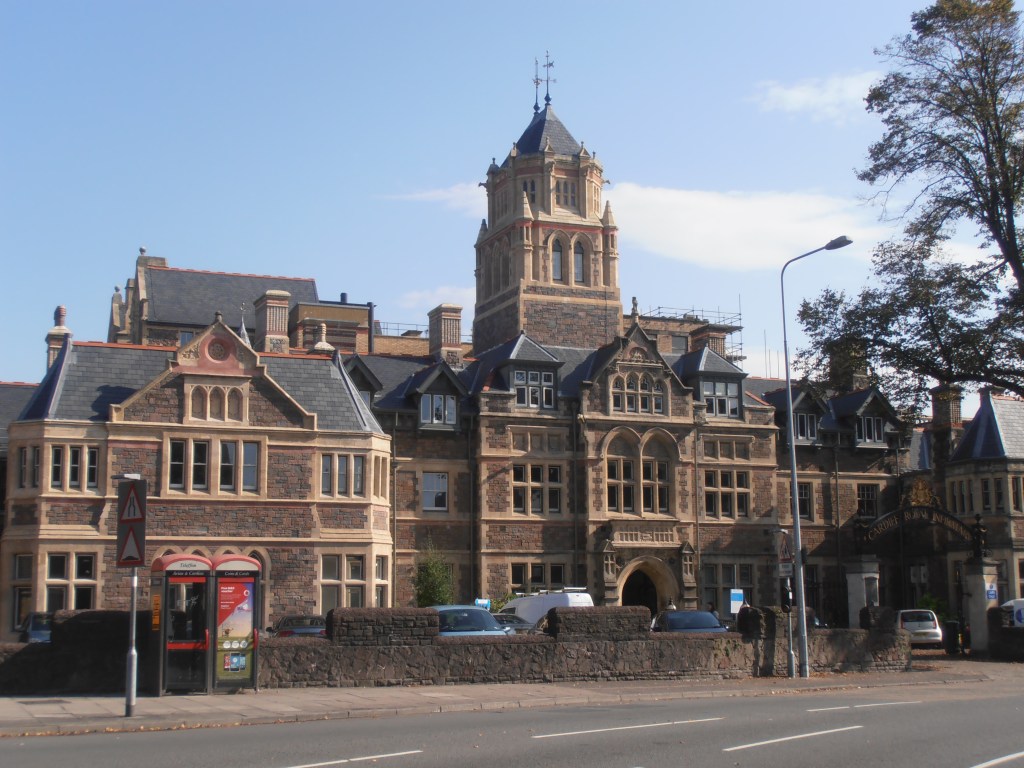
At the Royal Infirmary, Seward once again struck his balance between gothic fancy and neo-classical civility with an overall symmetrical facade made up of pinnacles and pediments, towers and cupolas, crockets and dormer windows all clad in stone and interspersed with that ever so Victorian feature, the chimney stack.
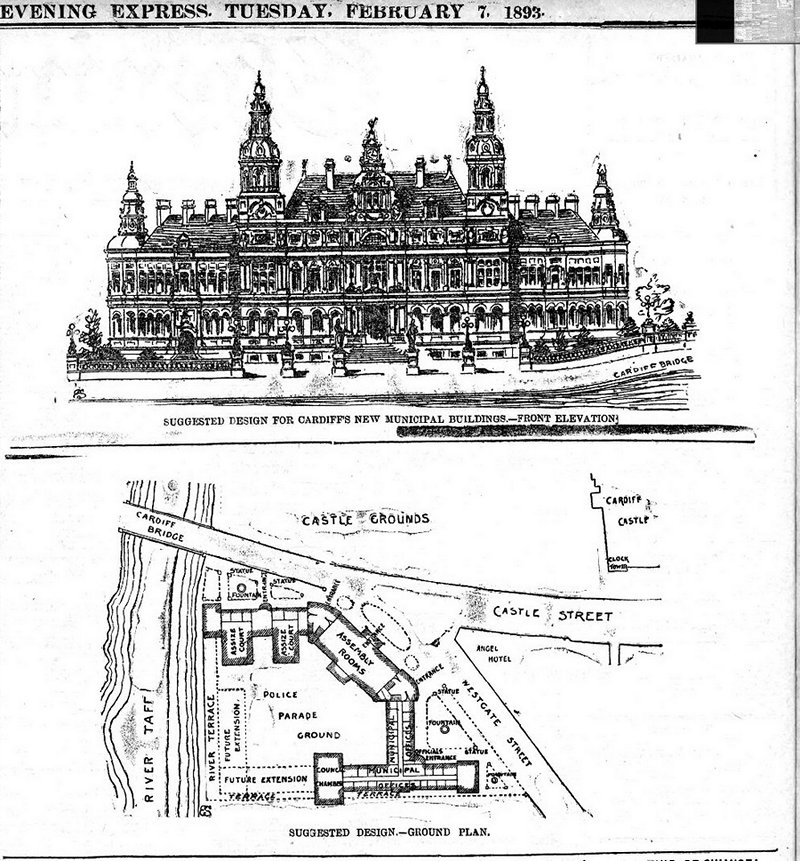
However, Seward’s ascendancy in his adopted hometown was to face increasing difficulty in the following decades. In the 1890s he proposed a grand new set of civic buildings on the site of what is now the Cardiff Arms Park and a Holiday Inn. This complex would have included council chambers, assembly rooms, municipal offices, and a police court, all arranged around a parade ground on the banks of the River Taff and facing off Burges’ Cardiff Castle across the street. The prototype would seem to be the Hotel de Ville in Paris rather than any Welsh or English building, although Seward’s elevations show something altogether larger and more heavily fenestrated, once again using classical elements to create an overall more gothic skyline of spikes and finials with a sharp Mansard roof and towers that certainly take their source as Wren’s City churches. The scheme was never built, nor was a second, only slightly more modest, design proposed by Seward a few years later.
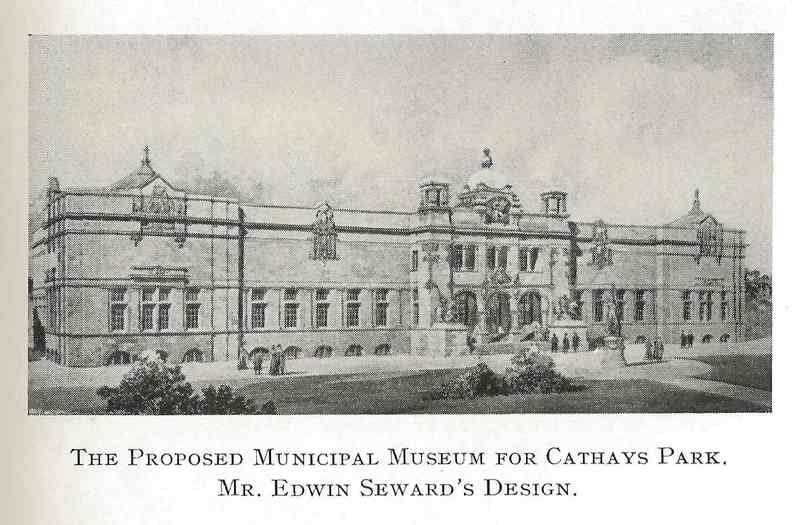
Neither were his plans for a city museum in the Cathays Park Civic Centre that was eventually chosen over his own municipal plans. This planned museum came up against the newly formed National Museum of Wales who were keen to become the primary institution in Cardiff and wanted their own architects to design something far grander than Seward had in mind. It is a shame as Seward’s design is sensitive and nuanced, clearly derived from his previous Cardiff commissions and thus matching the city style that he had done so much to establish, in this project Seward seems to have begun to adopt a slightly more modernist idiom, there are hints of Mackintosh, Lutyens, and Blomfield here with moments that could be considered proto-Deco. But Seward’s art-nouveau museum was never to be and the acrimonious fight with the National Museum seems to have marked an end to Cardiff for the ageing architect. As he left for Weymouth, where he would live until his death in 1924, a local paper noted, “Mr. Seward has removed to Weymouth, and his departure is a serious blow to the cultivated world in South Wales. Our loss is Weymouth’s gain.”
While Burges might have opened the door to an exuberant gothic-inspired style of architecture in Wales’ capital, it was Seward who really gave it its particular identity. To categorise him as simply a gothic revival architect is to do him a disservice for in his buildings, both realised and on paper, he gave Cardiff a vernacular of architectural eclecticism, of a cityscape that was not afraid of matching frivolity with late Victorian probity, a skyline of oriels not bays, spires not domes, pinnacles and clock-towers with a healthy dose of angels and cherubs thrown in. At once medieval and baroque, Edwardian and Elizabethan, art-nouveau and pre-raphaelite. Thanks to Seward, Cardiff’s architectural identity is all of these at once.
For more about Seward: https://cardiffnaturalists.org.uk/htmfiles/150th-26.htm
Enjoyed this article? Why not buy me a coffee to fuel more? Click here: https://ko-fi.com/morganhaigh

 Morgan Haigh
We as Hermes Publicly were the tenant of Jack Seward at the bottom of Churchill Way in 1964
LikeLike