
“[Railway termini] are our gates to the glorious and the unknown. Through them we pass out into adventure and sunshine, to them, alas, we return. In Paddington all Cornwall is latent and the remoter west; down the inclines of Liverpool Street lie fenlands and the illimitable Broads; Scotland is through the pylons of Euston; Wessex behind the poised chaos of Waterloo….Kings Cross had always suggested infinity…” – E.M. Forster, Howards End (1910).
London has what must be the most varied and exciting set of railways termini of any city in the world, one would expect not less of the capital of the country that gave birth to the modern railway. Thanks to foresighted Victorian planning laws, they all sit in a ring around the centre of London, they make no ugly scars through the urban fabric but rather stand as the old gates of The City used to, each with their own character and each with its own unique purposes. For E.M. Forster each possessed, in its architectural fabric, the latent spirit of those far away destinations to which their rails stretched. 110 years after Forster’s ode to these palaces of arrival and departure, from the age of steam to the age of electric, what spirit, if any, do London’s stations still possess?
Paddington
As did Forster, I begin with Paddington. This is my station, my gateway home to Cardiff and the path to many of the places I hold dearest: Oxford, Bath, St Ives, and Tenby on the Pembrokeshire coast. The fingers of the Great Western Railway stretch out to the very extremes of the country, to the tip of the Cornish peninsula at Penzance and the most westerly points of Wales. At times the lines run perilously close to the edge, trains skimming across the top of breaking waves at Dawlish. It also reaches up into some of the most pleasant little plots of England, the ‘other Edens’ of Oxfordshire, Wiltshire, and the Malvern Hills, the home of cathedrals, Elgar, dreaming spires and other cliches of Britishness.
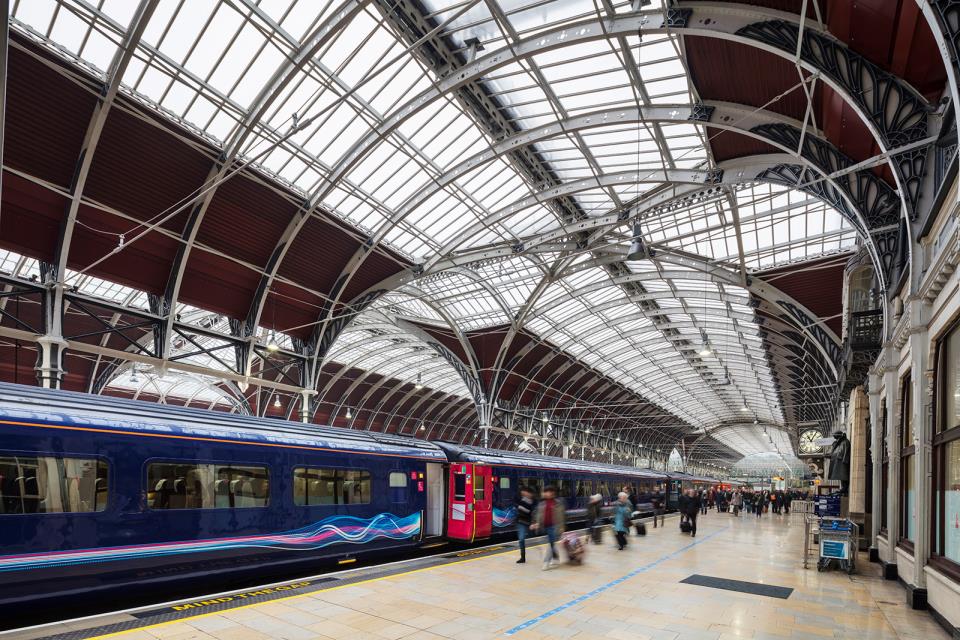
One would expect to find in Paddington, therefore, a mixture of raw rugged extremities and cosy, Cotswolds-y charm. Instead we’re given the most jaw dropping expression ecclesiastical industrialism. What Isambard Kingdom Brunel built here in 1854 is a multi-naved cathedral in glass and iron. Three great depressed arched roofs sit side by side, the middle and largest spanning 31m and all three running 210m in length. However, Brunel’s real genius here are the transepts that connect each shed to the next, creating that great focal point in any cathedral, the crossing. No other London station (or any station anywhere to my knowledge) has a crossing and transepts like this. I use these terms of ecclesiastic architecture to describe Paddington because there is simply no language in the lexicon of industrial terminology to express the design.
This is about as close to Paxton’s lost Crystal Palace as it is still possible to get, Paddington being completed three years later. It exudes the Victorian confidence in the future and British engineering ingenuity, whilst being made up of forms dredged from the past. At the end of the one transept the bay window of the old Director’s proprietorial office looks out onto the platforms, however being a building of nineteenth-century flamboyance this window is decked out as if it is a fine creation of the Venetian gothic, no Grand Canal below but instead a grand terminus. This hint of the exotic East is somewhat incongruous in a station that points so firmly west, but one is willing to be carried along by the whimsy after spending time under those roofs.
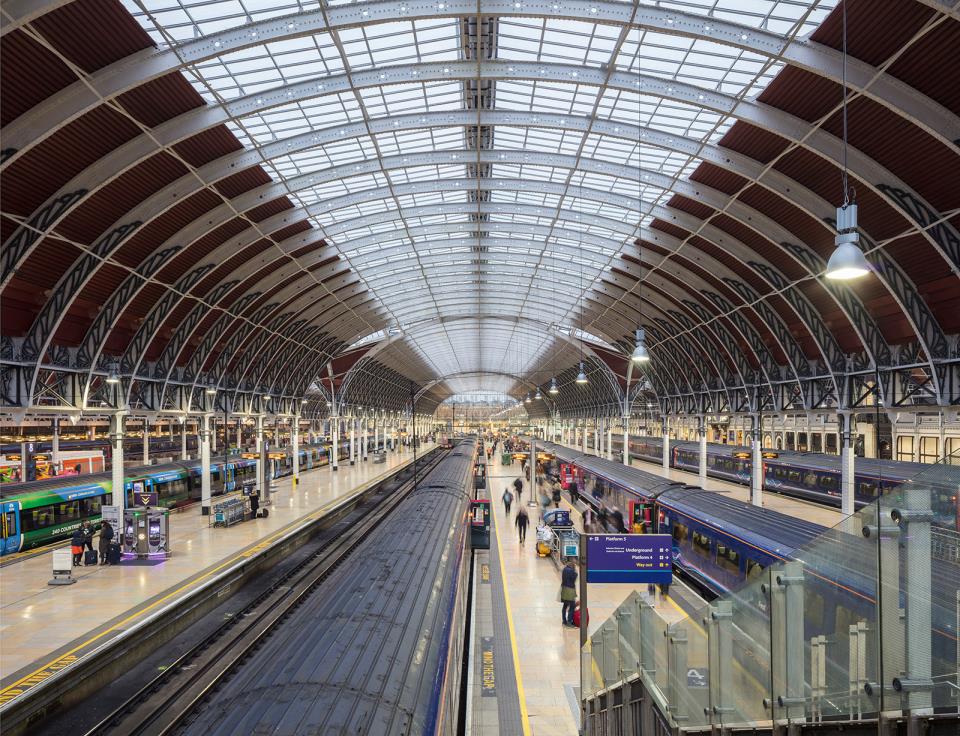
Can we find in Paddington the spirit of its destinations? Well, clear to see are the allusions to the great cathedrals of Worcester, Gloucester, Hereford, Salisbury, and Exeter. Brunel’s rounded arches and springing tracery are at once Romanesque and Gothic. The extreme is there too in the almost terrifying scale, both in length and span, of its constriction. Only matched by St Pancras in London, the feeling of being dwarfed by this enormous space is something to which no photograph can do justice and makes for one of the most triumphal ways one can enter the city. Despite its trains running firmly away from the rest of Europe, there is something assuredly continental about the echoing bustle of Paddington. There is, however, little of Wales in this building, the Celts being pushed to the fringes as is often the case.
This is true until one steps from the embrace of the glass canopies onto the street outside and suddenly all signs of the station are gone. Paddington has virtually no street facade, it does not announce itself like other London termini, its spectacular grandeur is tucked away behind larger, brasher neighbours. And there, one can draw parallel with Wales.
Euston
Euston is a complete disaster. It wasn’t always a complete disaster, for a while it was one of the most important and imposing complexes in London. But now it is a complete disaster.
You see, Euston was the first railway terminus in London, it opened in 1837 and provided the vital link with Birmingham, England’s second city. Later its reaches would expand to the equally important cities of Liverpool, Manchester, and Glasgow. Huge industrial centres, huge population centres, huge demonic Victorian metropolises, and very, very important.

Clearly whatever building was going to house Euston Station would have to be important, and when buildings need to be important they’re usually built in the classical style. The London & Birmingham Railway, as it was then, called upon the classically trained Philip Hardwick to provide the importance, and so he did. His primary method was by sticking an enormous Doric arch on the street outside. So enormous in fact that its columns were larger than any to be found in antiquity. The Euston Arch was a gateway, but not a gate to “adventure and sunshine” as Forster might have it, but a gate to serious, noble, Victorian industry. An intimidating edifice halfway between a grand cemetery and an ancient temple.
And behind it Hardwick built what was, for all intents and purposes, a temple. The Great Hall appears like a shrine to George Stevenson, his statue occupying the place of Athena in the Acropolis. Stevenson was responsible for Rocket, the first passenger carrying steam locomotive, the first passenger carrying railway, and indeed the London & Birmingham Railway itself. In other words he was the life giving god to the whole enterprise and Euston was to become the altar at which he was praised.
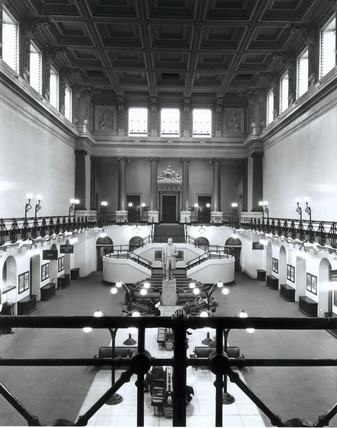
In the 1960s they flattened the lot in the name of ‘progress’ and with a flawed understanding of how to deal with capacity on the railways. Despite stirring efforts by many of the most prominent minds of the century, including one of my personal heroes Sir John Betjeman, The Arch and everything with it was pulled down. The only vestige that remains are the two little lodged, now housing a bar, that can be seen from the Euston Road.
In its place William Robert Headley and Ray Moorcroft built what is undoubtedly in the top five worst buildings in Britain. It is nothing more than a dark, long, low, featureless box, or more correctly a conglomeration of boxes. Despite the rather hopeful description on Wikipedia of ‘International Style’, it has no redeeming features.
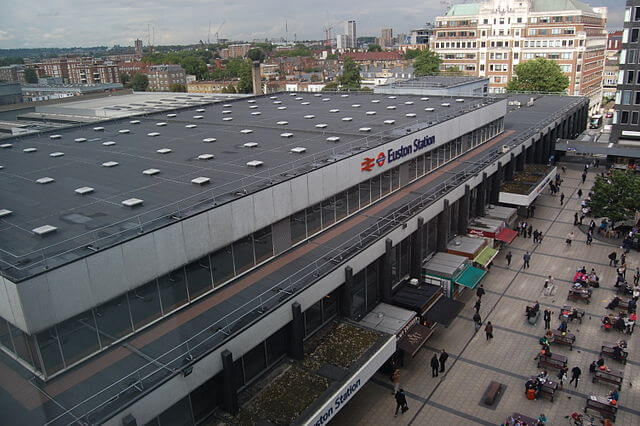
Many, many people more eminent than I have had their pop at this disaster of national infrastructure, some of the best come from Gavin Stamp: entirely lacking in “the sense of occasion, of adventure, that the great Victorian termini gave to the traveller”, and Richard Morrison in The Times: “The design should never have left the drawing-board – if, indeed, it was ever on a drawing-board. It gives the impression of having been scribbled on the back of a soiled paper bag by a thuggish android with a grudge against humanity and a vampiric loathing of sunlight.” For my own take, the featureless waiting hall is one of the singularly most depressing and congested interiors in London, and the dark and dingy platforms, in some strange purgatory between the surface and the underground, between arrival and departure, make one want to rush onto any train, going away where as long as it’s away from Euston.
So there you have it, Euston, once a noble and important temple to the gods and demi-gods of industry, now a national embarrassment and an insult to the name of that once great station.
Waterloo
Here is a station with an identity crisis. This sense of impermanence can be traced back to its origins, when it was opened by the London & South Western Railway in 1848, it was only intended as a passing stop on an extension from Nine Elms into The City. In those days it was known as Waterloo Bridge Station, the station subservient to the bridge and not the other way round as it feels today. It did not gain its definitive ‘Waterloo’ name until 1882.
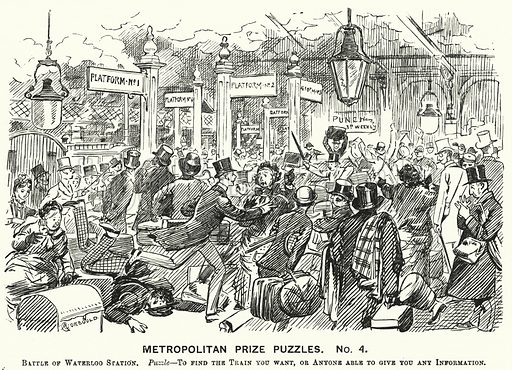
As plans for the extension of the line further east were caught up in financial and legal quagmires, Waterloo had to adopt the guise of a terminus, it had to play a part for which it was never intended. It offered the traveler none of the standard grand terminus services, no railway hotel or decorative waiting rooms. As footfall increased, platforms and booking halls were added to either side of the original station, in an ad hoc fashion, reaching a level of ludicrous complexity, each sub-station within the greater Waterloo having its own entrances and exits, its own ticket offices and taxi ranks. Platform One was to be found in the middle of the station rather than at the one end, and by 1899 the numbers 1 to 10 were used, and reused, to label sixteen platforms on several levels.
The confusion this caused was masterfully expressed in a passage of Jerome K. Jerome’s Three Men in a Boat:
‘We got to Waterloo at eleven, and asked where the eleven-five started from. Of course nobody knew; nobody at Waterloo ever does know where a train is going to start from, or where a train when is does start is going to, or anything about it….We went to Platform Three, but the authorities there said that they rather thought that train was the Southampton Express, or else the Windsor Loop. But they were sure it wasn’t the Kingston train, though why they were sure it wasn’t they couldn’t say.’
Jerome’s search continues in this vein until they eventually bribe the diver of the Exeter Mail to ‘slip off quietly and go to Kingston.’
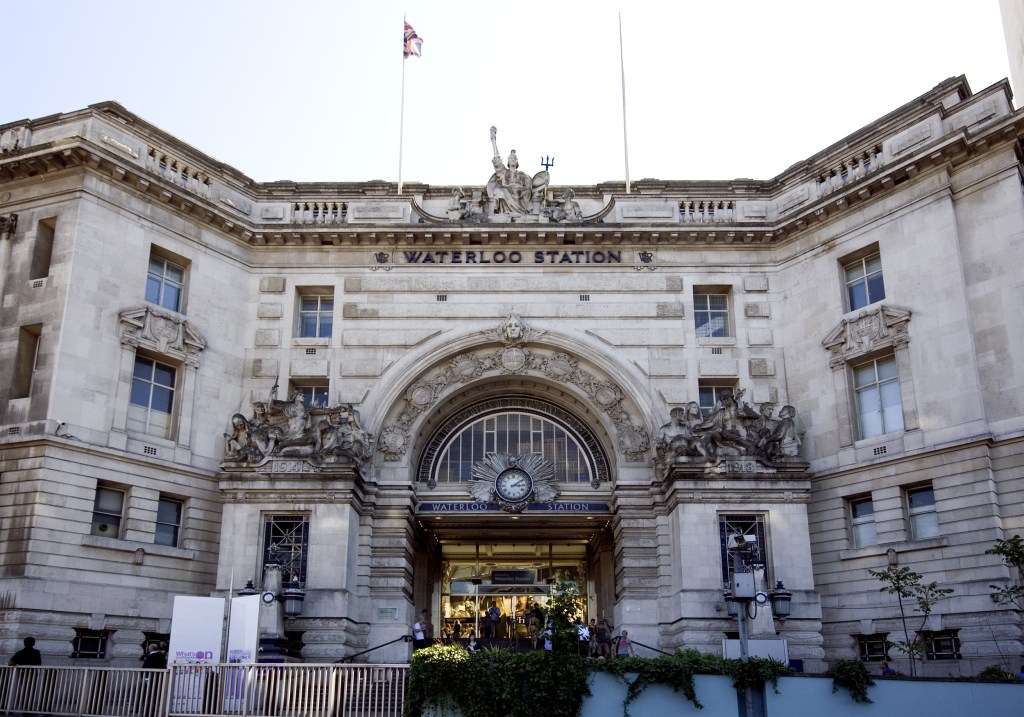
This confusion was eventually resolved in 1922 with the opening of a rebuilt Waterloo, the one which stands today. With the opening of the Waterloo & City tube line the station was finally resigned to its role as terminus of the L&SWR…although by the time the works were done the lines were under the Southern Railway.
The confusion of platform numbers may be gone but the confused identity reminds. Child of the L&SWR, raised by Southern, a reluctant terminus now operated by South Western Railway. Its grand imperial baroque facade by James Robb Scott includes a Victory Arch in honour of the First World War over one of the many entrances. This heavy and squat archway has none of the playful energy of the true baroque, it is corporate and urban, barely breaking the line of the office range on either side, it’s about as unobtrusive as baroque can be – thousands of people demonstrate this by ignoring it each morning and evening.
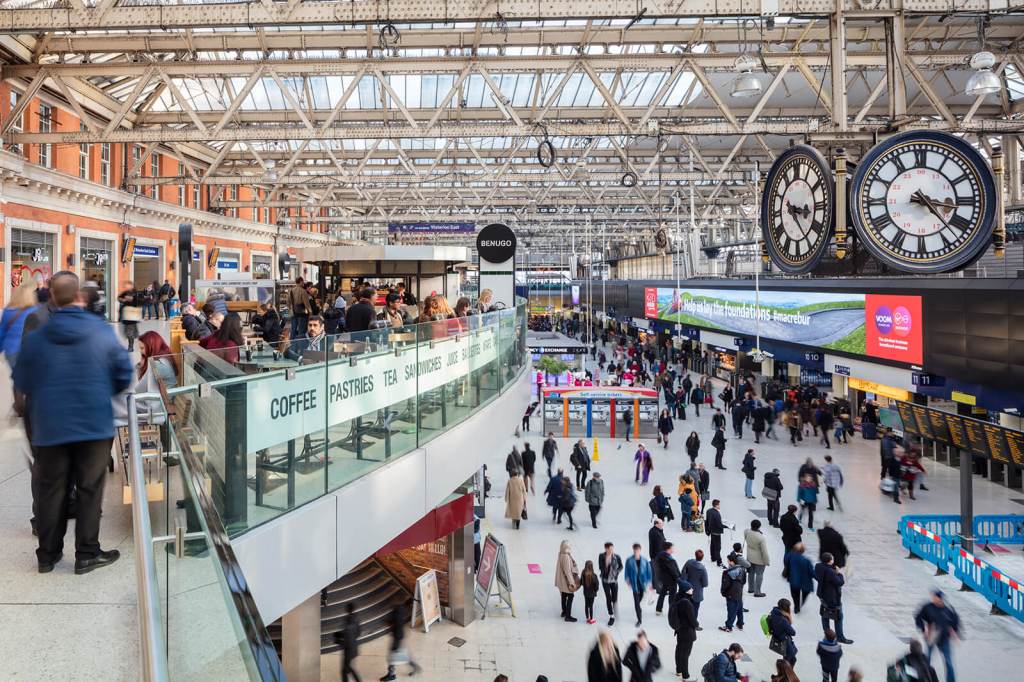
The platforms are covered by a utilitarian and functional glass and iron roof, not a graceful half-barrel or arch like Paddington or St Pancras but a row of interconnected triangular gables, like nine suburban greenhouses seen from the trains that stretch out into Surrey. The concourse is now more akin to a shopping centre with the view down the length of the station obscured by a rood screen of departure boards and advertising. That being said, in the surging crowds of commuters this station attracts, there is still a thrill in meeting a friend ‘under the clock at Waterloo’.
As if embarrassed by its mongrel history, Waterloo hides behind the elevated brick viaduct that brings the South Eastern from Charing Cross, just the very top of its facade peaks above the roofs of passing trains that sweep in a great arc before it. Because of this you can never get a very clear view of the station itself, judging by the sections that are visible, this might be a mercy.
Part 2 to follow…

 Morgan Haigh