25th January – 13th April 2020: ★★★★☆
Works on paper can often be seen as room-filler when a gallery can’t quite muster enough ‘proper works’, paintings and sculptures, to fill their space. They are normally objects that exist primarily in the realm of art historians, tools for them to unlock the secrets of an artist’s grander works. However, in the eternal struggle to find an original angle on that godfather of modernism, Pablo Picasso, the RA have dedicated an enormous show just for his works on and using paper.

Although, that is not strictly true. The exhibition also contains a fair number of paintings and sculptures in an attempt to draw connections between preparatory drawings and final works. Unfortunately these final works tend to overshadow their paper counterparts and rather detract from the paper-primacy thrust of the exhibition.
That is not to say there are not some brilliant works and fascinating insights to be drawn (if you’ll pardon the pun) from this show. Amongst these is the room dedicated to the development of Picasso’s ideas for his early masterpiece Les Demoiselles d’Avignon (1907). A selection of small, colourful sketches and larger detailed studies of heads and limbs reveal the careful but energetic process that went into the creation of the final work. With MoMA understandably not inclined to loan out their star work, the RA curators have installed a full size canvas print of Demoiselles, back-lighting it to give the facsimile a ghostly glow – really quite effective. Whilst this room is very interesting it still falls into the trap of displaying works on paper as subordinate to painting – something the exhibition’s texts refute.
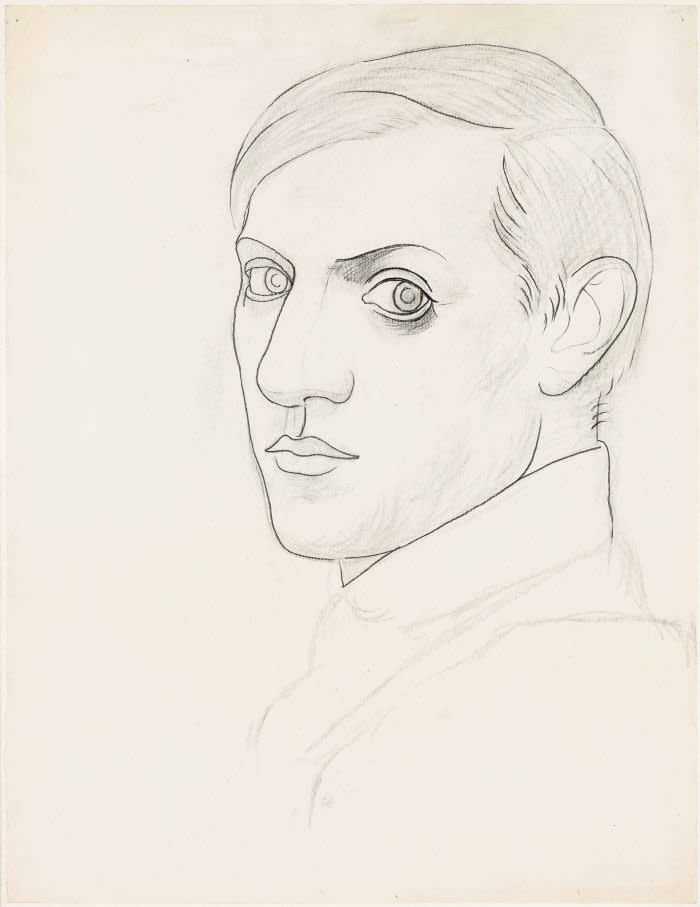
There is a popular myth amongst the hoypoloi that Picasso couldn’t draw – hence, of course, his faces with eyes and nose all over the shop. Not only is this wrong but also downright offensive to possibly the best draughtsman of the twentieth century – and this show proves it! Early on an exquisite study of the back of a man’s torso shows a young artist extremely skilled in modelling in light and shade combined with an acute understanding of proportion and the human form.
But for me, the zenith of Picasso the draughtsman can be seen in the portraits done in his neoclassical period, after the first war. A lesson in economy of line, these simple yet beautiful drawings take what he had learned of form and abstraction in his cubist years and apply it to the most literal form of depreciation. Certainly these crystal clear depictions of a generation of artists and intellectuals between the wars owe much to the drawing of Inges but with an added haunting sense of fragility. A particular highlight is the sketch of a young Igor Stravinsky.
A room displaying a series of prints drawings inspired by Manet’s Le Déjeuner sur l’herbe (1863) nicely ties Picasso into a wider story of modernism and demonstrates his respect for his forebears. Finally a show that doesn’t show Picasso existing as if in an artistic vacuum! Also revealed in this room is Picasso’s sense of humour and acute social observation when he is quoted as having said: “when I see Manet’s Le Déjeuner, I think there will be trouble later on.” One could see Picasso himself as the ‘trouble’ that is portent in Manet’s first steps towards what we call modernism.
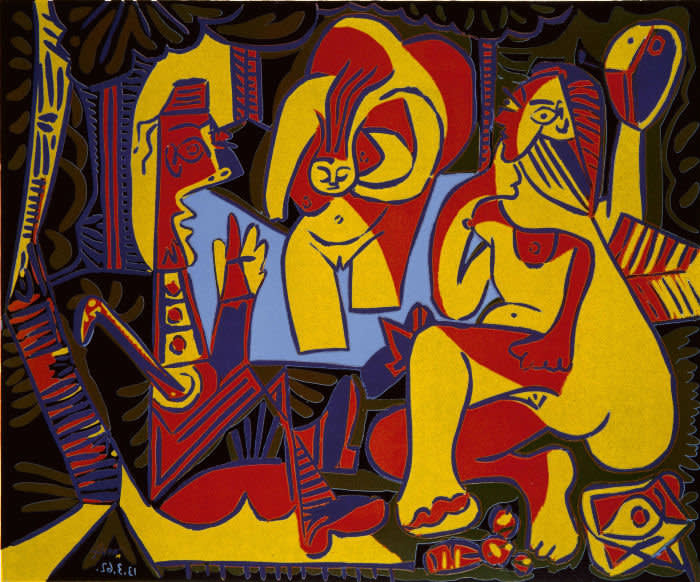
The one most vital thing that strikes the visitor to this show is colour. Works on paper sets up the mind or monochromatic, pencil or ink on a bank backing, a rather dull affair. This could not be further from the reality, with Picasso’s infamous blue and pink periods spilling off his canvases and into his drawings, in many cases out shining their painted counterparts due to the long lasting vibrancy of the inks. And later, in his collages and prints the kaleidoscopic nature of the works only intensifies. He spent his whole life attempting to return to the kind of naivety and purity of vision of a child and it seems, from this show, that it is in his drawings and collages that he gets closest to that goal. A perfect sunburst of colour for these dark, damp winter days.
The show is not without the large helping of hero-worship that is always reserved for modern art’s dead dad. And whilst for the most part the quality of the work stands up to this, there are moments when the mask slips. Picasso’s troublesome relationships with the women in his life are only given a cursory and airbrushed glance but their spectre looms. Whilst, at the end of the show, a clip from a mid-twentieth century documentary of the artist working live in felt-tip demonstrates for me that not everything the great man touched turned out to be gold. Whilst this is not the curator’s intended message, I did find it rather refreshing, a chink in the armour and a revealing human hit-and-miss quality of an artist who is often otherwise granted with a Mozartian infallibility.
★★★★☆

 Morgan Haigh