Tom Tower, Christchurch College, Oxford.
Sir Christopher Wren, 1681-82.
This was to be the greatest quadrangle in all England when finished, Cardinal Wolsey’s great theological college at the heart of one of the oldest seats of learning in Europe. Today, only its enormous footprint gives us any idea of the intended grandeur, the events of the break with Rome made sure of that.

In the early 1680s the college approached the foremost architect of the age, Sir Christopher Wren, to complete the old gate house, left un-topped in 1529, with a great tower. Unconventionally for Wren, he decided a late gothic style would best be fit the history and existing buildings of the institution. He drew up plans, handed them to the masons and washed his hands of the scheme, he never came to oversee the construction, he was too busy at St Paul’s.
This gothic turn made the Tom Tower the first significant building to be finished in that style in England for over a century and a model for the coming gothic revival in the following centuries. In essence Wren has taken the form of one of the shorter, pre-existing, octagonal flanking towers and simply enlarged it and its ogee roof to create the central tower, opening an elegant lancet in each face to allow out the call of the bell within. The Tom Tower, rather than being seen as an independent invention of Wren’s mind, ought to be viewed as a sort of restoration on what never was – whilst the effect is compelling, and the structure beautiful, one cannot help but feel that, if given entire freedom, Wren would have designed something rather different.
Blenheim Palace, Oxfordshire.
Sir John Vanbrugh, Nicholas Hawksmoor, 1705-22
How does one even begin to describe the only building outside of the royal and episcopal realms that is allowed the title Palace? Monstrous, it the first word that comes to mind – sitting there on an Oxfordshire hill side like an enormous spined crab, I think one would struggle to call Blenheim beautiful. It is, however, certainly imposing, possibly more so than any other house in England. The wide forecourt protectively flanked by arms that unfold from each side of the central hall herds you toward the powerful portico in the centre that opens to a classic Vanbrugh/Hawksmoor entrance hall.
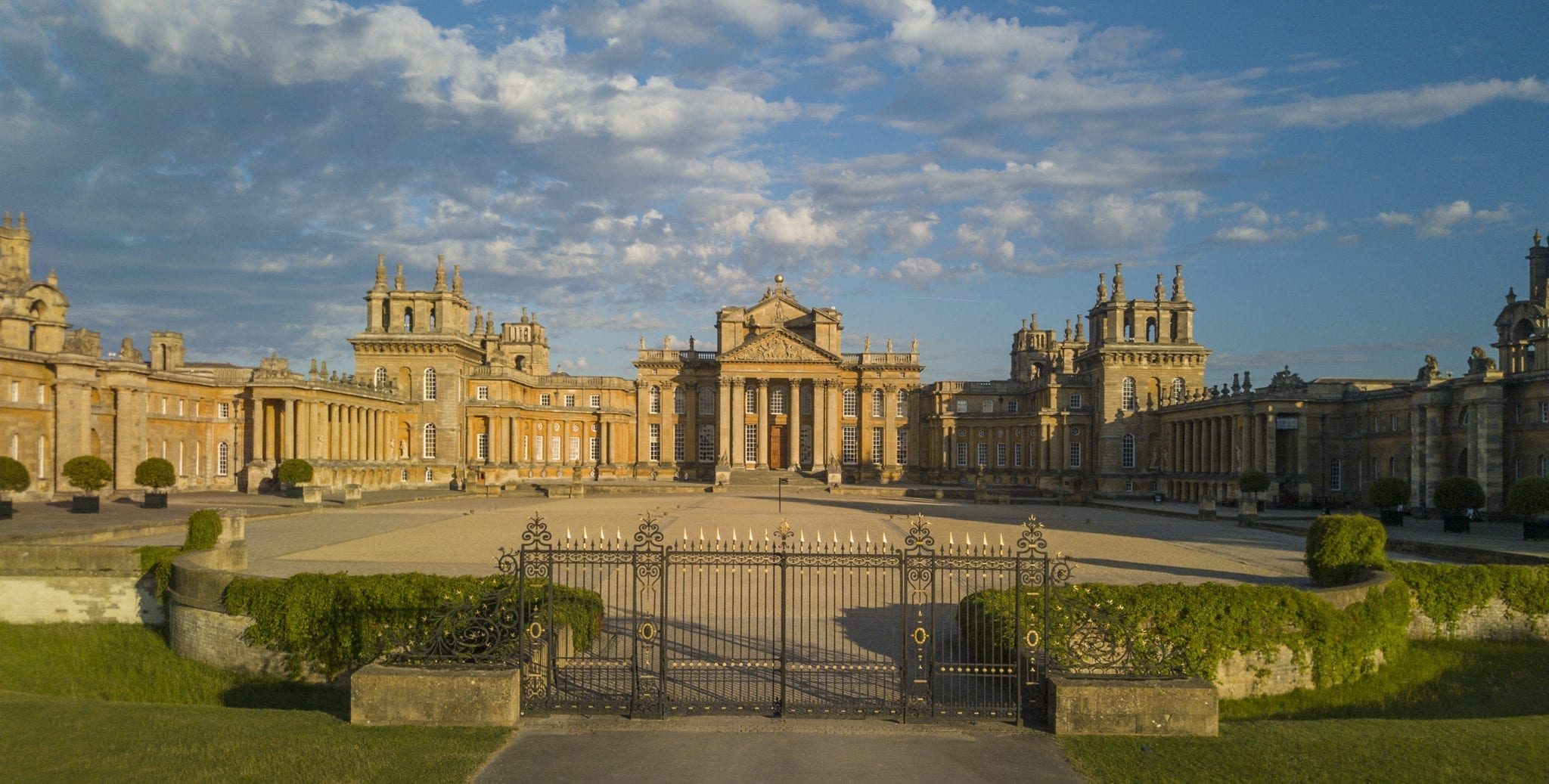
A high, impersonal room with none of the grace found in its counterpart at Castle Howard, this cold space is lit from an almost Romanesque series of lunette windows several stories above. The ceiling painting, although by the ever accomplished Thornhill, does not possess the vibrant agency of his work at Greenwich and one finds it quite easy to ignore – it’s simply too far up to make any real connection with the visitor. From here on in it is just room after room decorated in the classic Country Life photo-shoot style – the only exception are the impressive (but again, not exactly beautiful) tapestries showing generals on horseback and men of war.
The Duke of Marlborough’s great victory, that gave the name to the palace, is heralded from every sinew of this site. The bombastic decoration on the outside, the great monument in the grounds, the stolen bust of Louis XIV on the south front, and the sprinkling of heraldry and painting throughout the interior doesn’t let you forget it. And this was part of the brief for the building, it was not only a home for the Duke and Duchess but also the national memorial to the great victory – the functions not entirely symbiotic.
More interiors of soulless bravado lead eventually to the long gallery along the west side of the house. Designed by Hawksmoor, this is almost a carbon copy of his library at All Souls College a dozen miles away. Except here the monastic air has been extinguished and we find ourselves in a room that feels incomplete without being filled with bewigged and beauty-spotted revellers.

Where Blenheim is beautiful in on the south elevation. An expanse of level lawn stretches far out into the country, flanked by tidy bocage, to the distant church tower of St Martin Bladon, burial place of Sir Winston Churchill, descendant of the hero of Blenheim. The madness of ornament has been toned down on the rear facade and everything sits in perfect proportion. The central portico and hall is not quite as tall, the wings stretch east and west at a slightly lower height out to meet stocky bastions of pavilions at each end. The hand of Hawksmoor is clear in these pavilions, the cool simplicity, the unusual, mildly organic ‘eminences’ (his word) on their roofs remind one of the riots of the north front but not to the point of distraction. The key here, and something unachievable on the North side, is that one can get the entire composition of the South facade into one’s vision whilst still close enough to enjoy the details.
Saint Paul’s Cathedral, London.
Sir Christopher Wren, 1675-1708
Surely the zenith of English Baroque architecture and the most significant building constructed in England after the great gothic cathedrals and before the new Palace of Westminster, St Paul’s is nothing short of iconic. Its lofty, aspirational dome separates it from any other building in the country as a piece of seventeenth century Rome dropped in the heart of the medieval City of London.
:max_bytes(150000):strip_icc()/St-Pauls-Cathedral-5864408e5f9b586e029380a0.jpg)
But is this strictly true? Even the least trained eye could tell you that this is no Bernini or Borromini, but rather the creation of some of culture, inspired by those grand old Italians yes, but making its own statement on its own terms.
Wren was obsessed with domes. Maybe it is because there were none in England before him, or that they are a form of pure mathematics and thus a problem that needs solving. Regardless of his reasoning, there are few Wren projects that were not at some point planned with a dome in mind – many never to be realised. St Paul’s was nearly another one of these.
His first approach to the replacing of the old gothic St Paul’s, that had been engulfed by the flames of the great fire, can be seen high up in the Northwest tower of the cathedral in the form of the Great Model. This enormous wooden construction shows a centralised, Greek cross cathedral with a dome even larger than the realised one, with uncanny resemblances to St Peter’s, Rome. In a country very conscious and protective of its protestant identity, it is no surprise that this very catholic looking design was rejected.
The eventual approved design followed the new guidelines that the floor plan ought to mirror the traditional Latin cross of the old cathedral and other gothic ones across the country. And Wren replaced his grand dome with an unwieldy telescopic spire pillowed on a low, flattened dome that is nothing more than an unhappy compromise. It appears, however that Wren had no intention of building this cathedral as, as soon as this design was approved (with the caveat that the architect could make any changes he felt necessary as construction went on) Wren ceased to produce any further designs. Until around thirty years later the scaffold came down to reveal one of the most graceful domes in all of Europe.
Whilst the cathedral makes a harmonic ensemble from without, the unhappy union of gothic floor plan and classical dome make for an uneasy interior. Once one passes through that enormous portico, the nave is comparatively narrow and tight, not at all unpleasant, but not what one is led to expect by the exterior. The visa from the west end gives little of the domed crossing away, and it is not until it is right on top of you that the true glory of that space is revealed.
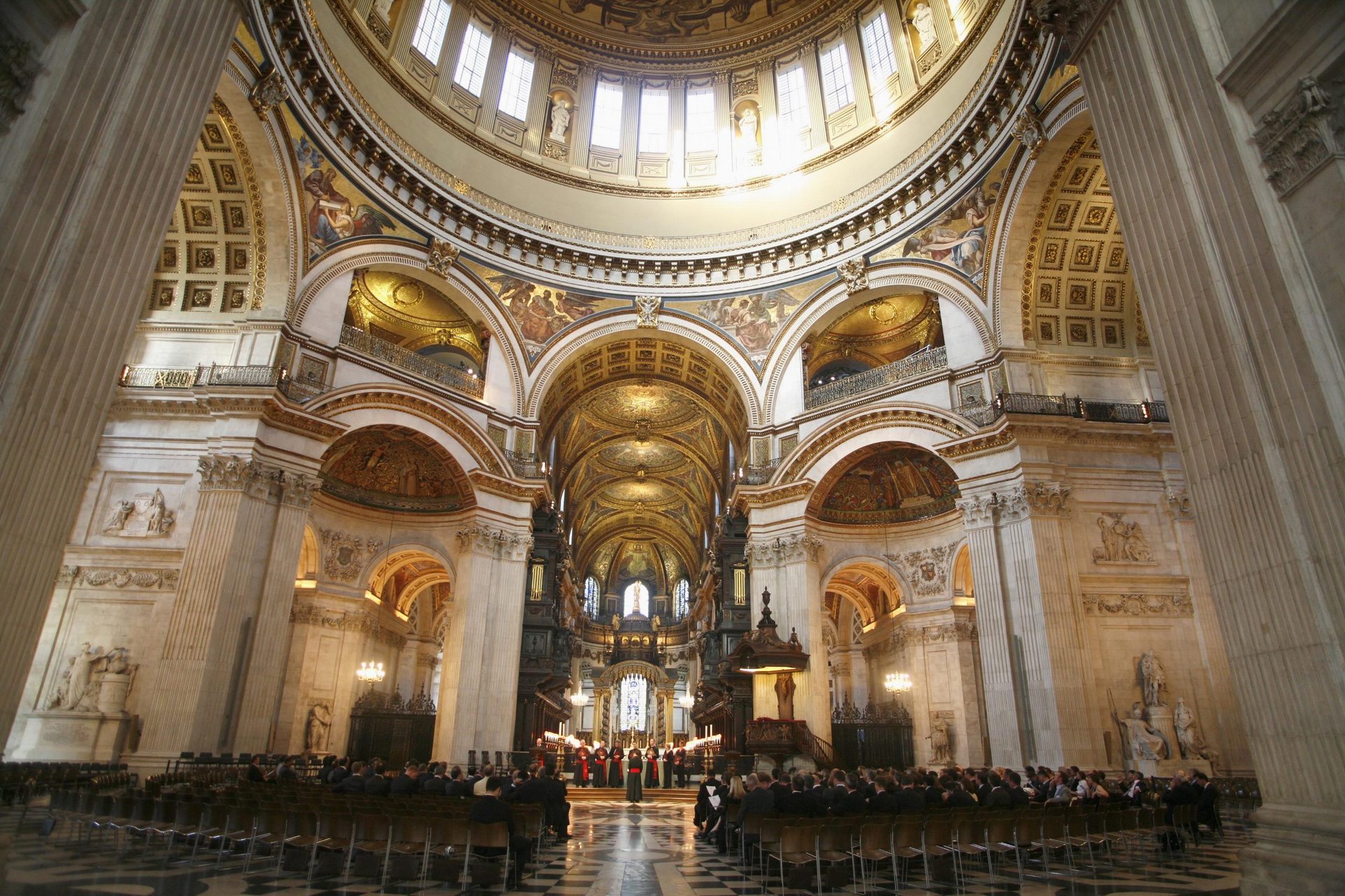
The experience is much like crawling through a narrow passage only to emerge in an enormous, light filled cavern. The receding layers of Wren’s dome drag one ever upwards to the point where the dot of light from the lantern passes into the cave below. The raised height of the stubby transepts extend the space to the North and South and give just the faintest flavour of what Wren’s centralised Great Model plan could have been. From there, to the East, its back into the narrow and low, made to feel even dingier than the nave by the hangover from the experience of the dome, and the heavy Victorian mosaic decoration that flies in the face of Wren’s clarity of vision.
In essence, St Paul’s is two unfinished buildings. A baroque refacing of a gothic cathedral that has been cut in the middle and spliced with the architecture of a visionary kept from absolute freedom by the religious establishment. If Wren’s nave and choir belong to the human, corporeal world, then the crossing allows us a brief glimpse towards heaven.
Castle Howard, Yorkshire.
Sir John Vanbrugh, Nicholas Hawksmoor, 1699 –
For me, the supreme stately home in all England, Castle Howard is another product of the Vanbrugh/ Hawksmoor collaboration. Perched on a ridge amongst the rolling Arcadian landscape of the Howardian Hills, its imposing form is hidden from the visitor until the very last moment. Instead we are led from monument to monument along a grand avenue, passing under pyramidal gates and through ancient walls, until, where one would expect the house to be revealed, we are faced with an enormous obelisk blocking out path. Here a right angle turn is taken and the house is finally approached by a side route.

This unorthodox route allows for uninterrupted vistas on the landscape from the north and south fronts, and means that, when one does get a glimpse from a distance, the full effect of that extraordinary outline is enjoyed unimpeached. And what an outline it is, being the only private home in England to have a dome on this scale it has become iconic (help by the 1980s television adaptation of Evelyn Waugh’s masterwork Brideshead Revisited). The rectangular block underneath the cupola is essentially an arrangement of arches within arches in order to support the immense weight of the masonry above. At its core is the towering space of the central hall, on top of which the lantern and dome sit. The space is much like a set from an opera, with various entrances and exits, balconies and staircases, all lavishly painted with your standard playbook of classical and mythological illusion.
Of the two wings that hug the court on the north front, in similar but smaller fashion as Blenheim, only the east was completed to the original designs, the westerly one is a later and much larger Palladian invention and precludes the completion of the symmetrical site but taking the place of the a service court originally planned to match that to the east. Whilst neither this wing’s exterior or interior fall within an exploration of the baroque in England, it is worth mentioning the rather impressive, neoclassical, catholic chapel snugly ensconced within this part of the house, with in interesting arts and crafts decorative scheme.
It is the south front that gives the best impression as to what the overall intention was here at Castle Howard, the garden wing running through the main block and out to either side, disguising the later Palladian additions. When the sun shines across the distant moor and grand lawn to bounce from the honey coloured stone of the south façade, one can be left in no doubt that this is one of the architectural set-pieces in Britain.

Scattered amongst the handsome grounds are some of the most unusual garden monuments and follies of any estate. Whilst Hawksmoor’s unsettling and paganistic pyramids exist in the distance, outside of the formal gardens, Vanbrugh’s Temple of the Four Winds offers a deeply neoclassical observation point from which to look out across the impressive country. And within this view is placed the most impressive of the garden structures, Hawksmoor’s mausoleum for the family’s dead. Springing from Bramante and the ancient Roman tombs of emperors, this bold tempietto sits at a distance from the house and nestles in the hills like a motif from a painting by Poussin. Whilst a wonderful and creative piece of architecture in its own right, it is the acute awareness of its relationship to the landscape and the rest of the estate that makes this one of Hawksmoor’s masterstrokes.
Later London Churches
Nicholas Hawksmoor, 1712-c.1731
The final entry in this guide and possibly the most slippery to deal with. Many people have written on the six London churches of Nicholas Hawksmoor and none have managed to encapsulate the aura of these buildings. I do not claim to either, as they still baffle and confuse me, but they are certainly some of the most extraordinary constructions in London.

Concerned with the growing communities of non-conformists and French Huguenots to the east of the city, in 1712 the Tory government commissioned fifty new churches to be built in the area. Whilst both Wren and Vanbrugh were asked for advice in the scheme (Vanbrugh offering his now infamous “solemn and awful” ideal), it fell to Hawksmoor to design some of the churches – in the end the only ones to be built in the imitated aftermath of the commission.
St Alfege, Greenwich, the first to be begun, sets the tone for the others, enormous blocks of white stone carved away deeply and geometrically to create windows and doorways (see Clarendon Building, Pt.2). A basic rectangular form with a tower over the west door. The space inside is big and wide with a flat roof, everything about its nature is quiet and monolithic. As Waldemar Juanszczak said, one can imagine a funeral taking place in a Hawksmoor church but not a wedding.
The great marvels at St Alfege, St Anne Limehouse, St George in The East, St George’s Bloomsbury, and Christchurch Spitalfields, are their steeples. Hawksmoor takes what Wren started in his city churches and turns it up to eleven. Octagonal ‘gothic’ style lanterns made up of imagined classical spolia, or Moorish pepper-pot cupolas. The best of them is at Christchurch, with Norman spire on top of a Roman triumphal arch on top of a Palladian Venetian window that has been inflated to the size of a deep two story porch – then, to top it off, you walk to the side and see that he has taken enormous Borrominiesque scoops out of the the structure giving the whole thing an instability that at once marvels and terrifies.
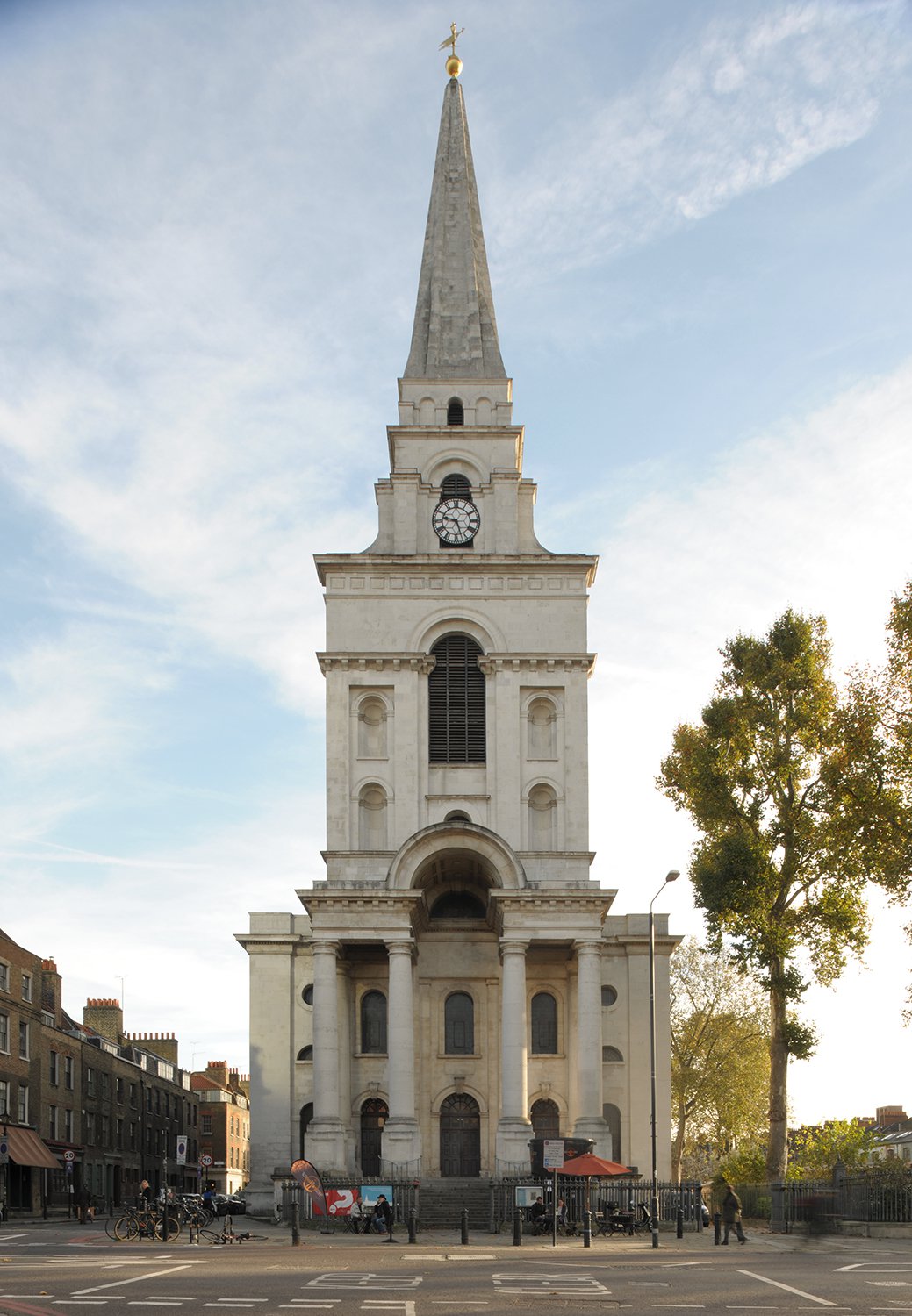
Hawksmoor was never afraid of architectonic mass, his churches like the refined detail of Wren’s, but they do often possess greater gravitas. They are made up of large, strong forms, the square, the circle, the arch, and the pyramid, all being used as the fundamental building blocks of classical architecture.
The smallest but densest of his churches is St Mary Woolnoth, the only one to be within The City, Wren territory. Small due to the constraints of the site and lacking a tower, this rock of a church could almost belong to the art deco, with its deeply channelled geometric masonry being stylised Egyptian. However around the north side we see once again why Hawksmoor has been called the ‘lopsided Borromini of Blenheim’ with some fascinating niches containing chunks of highly finished but twisted aedicules. There is no practical function for these, other than filling blind fenestration, they are just the flight of fancy of the mind of the architect.
And in many respects that is what English baroque architecture can be described as. Certainly it does not sit together stylistically, swinging between the classical and the gothic, between Wren’s utilitarian logic and Vanbrugh’s stage sets, but we can understand the baroque as giving English architects the freedom to play, to invent, and to discover new idioms in the building of Britain.
Enjoyed this article? Why not buy me a coffee to fuel more? Click here: https://ko-fi.com/morganhaigh
With thanks to Dr Emily Mann, Rose London (Courtauld Institute of Art) and Dr Anthony Geraghty (University of York).

 Morgan Haigh
One thought on “Haigh’s Guide to Baroque Architecture in Britain: Part 3.”