
The Old Royal Naval College, Greenwich.
John Webb, Sir Christopher Wren, Nicholas Hawksmoor, Sir John Vanbrugh & others, 1672-1712.
What is there left to be said about that grand old complex on the river that does not pale in comparison to the vista from Island Gardens? For it is here, on the north bank of the river, in a rather scrappy little park, that one should start a visit to the site. From here you can take in the whole of what Kenneth Clark described as “the greatest architectural unit built in England since the Middle Ages” from its optimal axis. Place yourself in line with the central bay of Jones’ distant Queen’s House, and marvel at how generation upon generation have unfolded their plans up the banks of the river – from Webb’s staunch blocks on the foreshore up to Wolfe’s silhouette on the hilltop.

First envisioned as a replacement to the old Tudor royal place, then as a hospital for old sailors (a counterfoil to Chelsea), eventually co-opted as a training school for the Royal Navy, and now home to various elements of the National Maritime Museum and institutions of higher education, maybe it is because of this lack of clear direction that architecture has been freed to play its own game – with the function just having to fit the form.
In his King Charles block, the oldest part of the hospital complex, Webb sets the tone for everything that follows, a tone that he in turn took from Jones’ but which he amplified and inflated. The giant order here seamlessly retreats to Wren’s delicate, yet sturdy and rhythmic colonnades that frame the site and draw cohesion between its parts. Inspired by Les Invalides, Wren dreamed of a large central dome at Greenwich (as he seemingly did at every site at which he worked), but, constrained by the requirement to preserve the river view of the Queen’s House, his dome goes through mitosis, giving us the double domed skyline now synonymous with Greenwich. Wren’s genius is always most obvious when he was limited by either a difficult site or a difficult client, take the City churches for example.

Both Hawksmoor and Vanbrugh attend this architectural ball, although they are masked from us in the cross-river view. To discover their work one must forsake the macro for the micro and go amongst the many wings and courts. There the fancy denied by Wren is allowed to fly free, especially in Hawksmoor’s King William Court which is a virtuosic showpiece of massed ornament that manages to avoid ugly decadence. It leaps, skips, and dances for joy whilst at all times feeling strong, ordered, and stable.

If one could only visit one room in all England, the Painted Hall would surely top the list. The Latin inscription painted on the back wall, Iam Nova Progenies Coelo (Now, a new generation of heaven), is intended for the first of the Georgian dynasty who are shown below it and to connect them with the line of monarchy painted throughout the hall, but one cannot help to see this as referring to the generation of artists who, in this heavenly space, created something wholly new in England. Wren’s glorious building, Hawksmoor’s imaginative ornament, and Thornhill’s breathtaking painting combine to create the best gesamtkunstwerk on British soil.
The Sheldonian Theatre, Oxford.
Sir Christopher Wren, 1664-1669.
Wren the wunderkind’s first great showpiece, The Sheldonian, sits right at the heart of the University of Oxford, both literally and ceremonially. For such a prestigious building Wren was the obvious choice, he was one of their own, an Oxford man from a royalist, established, family and a name that already carried weight, albeit not yet for architecture.

The real energy of this building comes from the tension between interior and exterior. The multi-storey façade belies the large, single chamber within. Wren’s rusticated arcade holds two different forms of fenestration but it is only once inside that one realises they open onto entirely different spaces – the lower windows providing light for an outer corridor and the lunettes opening onto the theatre itself. Ever the pragmatist, this allows Wren the raked seating without the issue of blocking windows.
The real marvel of the Sheldonian when built was the enormity of the seemingly unsupported ceiling, a classic Wren trick of geometry in the rafters, but even to this day there is something slightly uneasy about the large, flat ceiling with its frankly gaudy Anglo-Rubens painted pastiche.
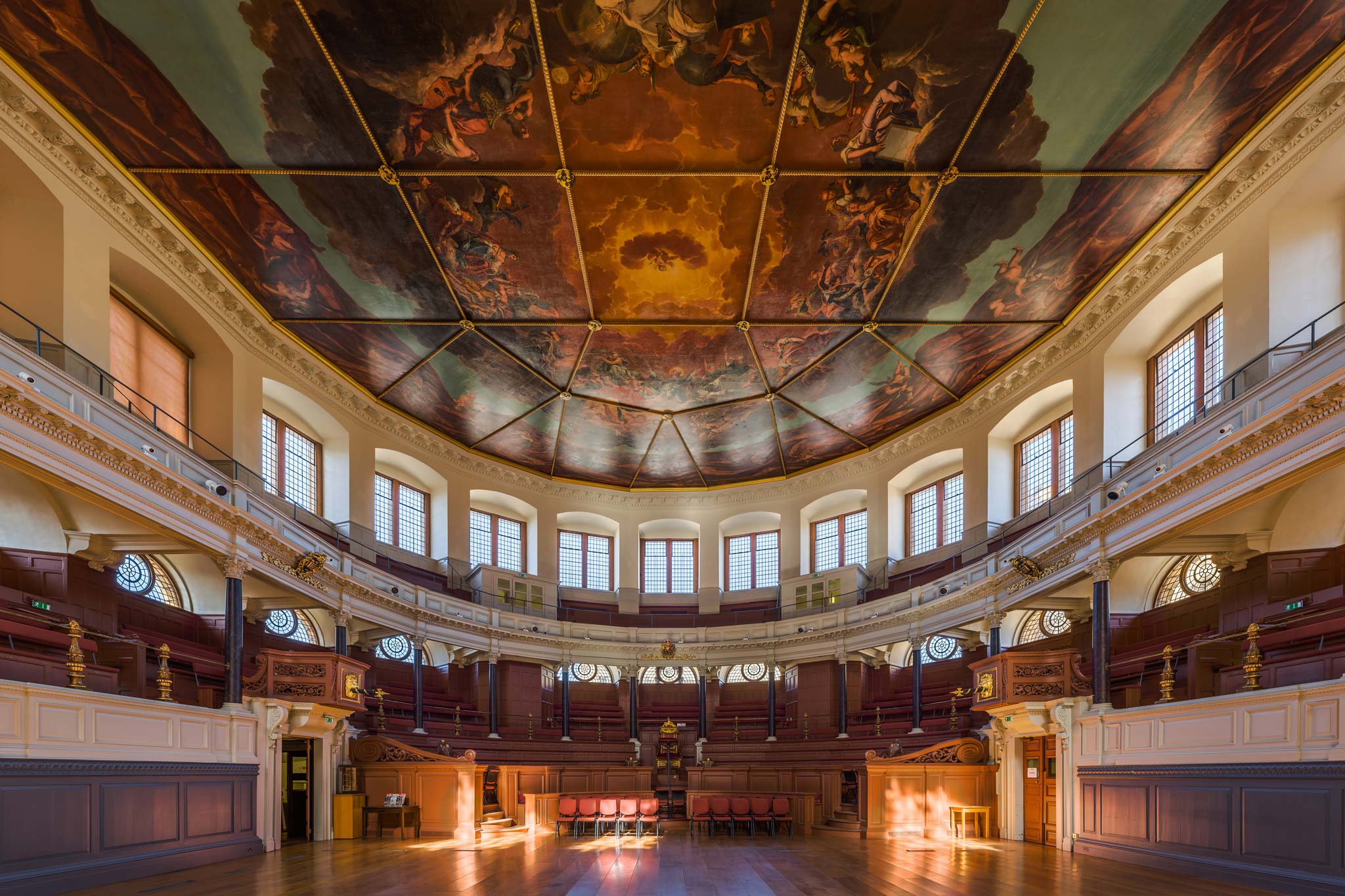
This is a building of dualities, as we have already seen in the interior/exterior conflict and harmony, and again, within the theatre, one is hard pushed to define the building’s centre. Is it the Chancellor’s throne amongst the semi-circular seating or maybe the large south door under the grand organ, through which the great and the good of the University pass on ceremonial occasions?
Externally we find this same dichotomy, us mere mortals must enter through the north door, facing the Broad, at the apex of the apse end, although a grand entrance, it is not until one walks around the ‘back’ that one sees what is the true entrance. A grand frontispiece, about as close as Wren ever gets to strict Palladianism, is set up in direct opposition and extreme proximity to the perpendicular gothic of the old Divinity School, creating, in this quiet courtyard, the perfect microcosm of Oxford architecture. Due to the confines of the space, one can never get very far away from the Sheldonian and so it’s façade permanently looms over you which, if it wasn’t for the feathery gothic next to it, might become oppressively academic.

Wren places the final keystone of his plans not, in fact, on the Sheldonian but rather on the Divinity School in the form of a delightful ogee arched doorway, slotted seamlessly into the base of the highly traceried central window. This clicked into place, the great ceremonial route into the theatre is set and charged with symbolic few yards as the Oxonians leave behind the gothic and enter the baroque.
The Clarendon Building, Oxford.
Nicholas Hawksmoor, 1711-1715.
Slotted beside the Sheldonian Theatre is the work of Wren’s pupil, Nicholas Hawksmoor. When the Oxford University Press outgrew its home in the basement of the Sheldonian, the University turned to Hawksmoor to design a new press to reflect the increased importance of the institution.

Hawksmoor’s work here is heavy, it lacks the grace of Wren but establishes an arresting weight and presence that is hard to ignore – one could walk past the Sheldonian unconsciously, not the case at the Clarendon. Its great surprise is that it is not part of something larger, the scale of its conception belies its relatively modest footprint. It’s ornament is Beethovenian in its confidence, simplicity, and depth. Each window, pediment and niche cuts a good half a foot further into the fabric of the building than it really ought to, and yet the result is nothing but stabilising and harmonic.
When one walks through its central, open ended passageway from the Broad into the Bodleian’s complex, one feels one ought to have passed into another world, such is the effect of a triumphal arch become office building.
All Souls College, Oxford.
Nicholas Hawksmoor, 1715-16, 1730-33
If the Clarendon is Hawksmoor at his heaviest, then All Souls is its counterpoint. Less than five minutes walk from the former, his work here has all of the playful lightness of an institution designed to hold centuries of youth.

Looking at the rising, twin spindles of the main towers, one cannot help but feel the architect preferred the Gothic, there is an enthusiasm in his placing of the enormous buttresses and forest of finials that is lacking from some of his more classical designs. Here, Hawksmoor avoids the heaviness found is some of his other buildings by repeating, almost ad nauseum, the thin vertical. Almost every detail runs up to the roof-line and then flowers in a crocheted pinnacle.
The site is not a square one, laid on medieval lines, but Hawksmoor has tidied this up by altering the regular dimensions of his great Codrington Library to present, on the quad side at least, an equalised space. The result is that each end wall within the library is angled, making it the longest room in Britain, depending from which point you measure. Despite the interior fittings of the library (also designed by Hawksmoor) sitting firmly in the Enlightenment, the room still holds a medieval, monastic air of learning that is not achieved by many more flamboyant libraries of the age.

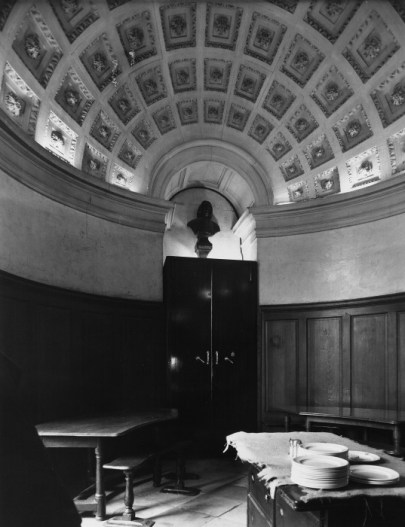
The room known as The Buttery appears like the smallest, jewelled reliquary in a great gothic abbey. Hardly larger than a broom cupboard, it sits at the one end of the Great Hall, separated by a vestibule. Built, not for the production and storage of butter as the name suggests, but rather to dine the esteemed Fellows of the college, Hawksmoor elevated this tiny room to match its function by coffering its shell-like ceiling within an inch of its life. The effect is almost baffling to the eye, the constantly shifting, geometric, plaster forms constantly compensating for the every changing angle of the roof. One must imagine that, for the Fellows, it feels like eating ones meals within a lemon meringue.
All Souls was intended to be part of Hawksmoor’s grand scheme for Oxford, a great central plan of a city built along classical lines, with significant buildings (designed by him, of course) in all the right places. His plans (one might say fortunately) never came to fruition and, although the great cylindrical, domed library he envisioned for the square outside All Souls was built, it was to plans by James Gibbs and not his own.
Enjoyed this article? Why not buy me a coffee to fuel more? Click here: https://ko-fi.com/morganhaigh

 Morgan Haigh
One thought on “Haigh’s Guide to Baroque Architecture in Britain: Part 2.”