
The Banqueting House, Whitehall, London.
Inigo Jones, 1619-22
To begin at the beginning, or maybe it’s the end of what came before. Jones’ magnum opus certainly marks a sea-change in the English architectural tradition, testified to by the fact that this mighty edifice, which dips its toes in Tudor waters, sits in perfect harmony with the later revivals and pastiches of the rest of Whitehall.

It fits in so well, in fact, that one is in danger of losing it amongst the cupolas, spires, and finials of the great offices of state. This was far from the case when it was constructed, at the heart of the medieval jumble of the old Whitehall Palace, the Banqueting House would have stood out like an unavoidable wedding cake in a gingerbread village – now it is camouflaged amongst other creations of icing-sugar classicism.
The façade provides us with one of the very first examples of the regular rhythms of the classical orders on these shores, although, this is interrupted by a heavy horizontal architrave running around its midriff. Almost like a belt that strains to contain a bulging contents.
And what could be more bulging, overflowing, and downright gouty, than Rubens? His rosy cheeked, voluptuous, allegorical maidens play amongst the ovals and rectangles of the architectural setting of his mighty ceiling paintings and, along with a slightly bemused and senile looking James I, draw your eye away from Jones’ cool, calm, ordered, double cube chamber and up into a very Stuart, borderline catholic, vision of heaven.
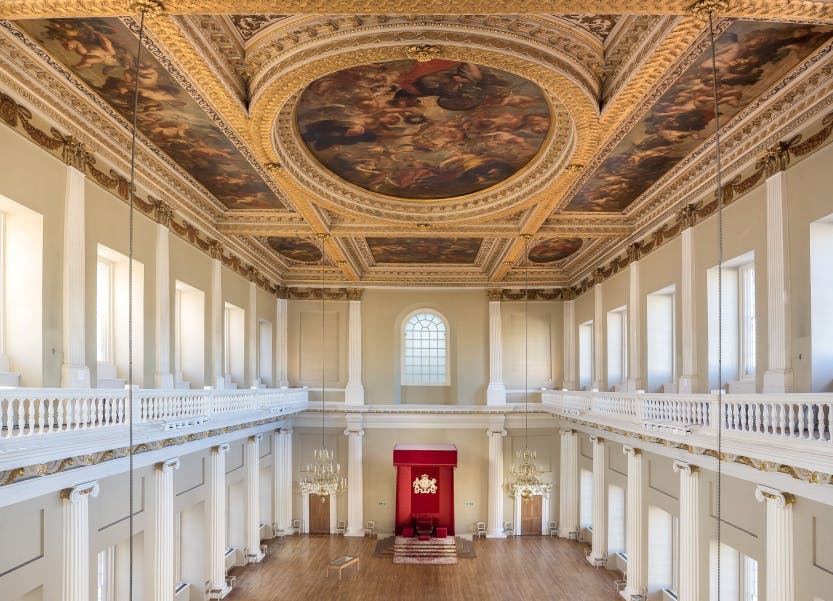
Its through Rubens, rather than Jones, that the true spirit of the baroque enters the Banqueting Hall. Without his paintings it is likely Jones’ work at Whitehall would join with his Queen’s House down the river, in being safely neo-classical. Although, with this building, much of its claim to the baroque is not found in its physical form but rather in the events it hosted. Not just the exorbitant masques of the reign of James but also, one of the most dramatically baroque events in this nation’s long history, the execution of his son, Charles.
The Monument, The City of London.
Robert Hooke & Sir Christopher Wren, 1671-77
Today, ganged up on by some of the worst examples of postmodernist, corporate architecture in The City, and divorced from its prominent position on the London Bridge road by urban planning, The Monument can seem something of a disappointment. Yes, it does still feel quite tall when one stands at the base, but for my money the best angle one is to catch a shimmering glimpse of that golden chalice of flame, bursting over the rooftops from a distance.

This is not an all singing, all dancing monument. It means to convey one thing: strength. A singular Doric column that stands proud of any superstructure, whose existence is an end in itself. This gives it a presence that is as bold as brass. Although a little ambiguity creeps into this stability when one considers to whose strength it acts as a memorial. If the Latin inscriptions and florid relief by Cibber on the base are to be believed, it is the strength and generosity of King Charles II in the aftermath of the devastating fire. If the rest of the structure is to be interpreted, it is in praise of a resurgent and fiercely independent City of London.
Regardless of interpretation, Cibber’s extraordinary carved scene can be appreciated as one of the best to be found in London with a fluidity and easy of hand that is uncommon in English relief work of this period.
Being the brainchild of two men of science, Hooke and Wren, there is, of course, hidden function to The Monument. Conceived as a zenith telescope, a small hole in line with the centre of the spiral staircase within the column allowed for observation of the night sky – or at least it would have done had the traffic rumble from the London Bridge Road not been too disruptive for the delicacy of scientific instruments.
The view from the observation deck, just under 200ft above the ground, displays the increasingly sullied and ill thought-out skyline of the financial centre, but also views out to the west and south that, with a little imagination, can be more easily married with the experience of a late seventeenth century observer. For them, The Monument would have acted as the perfect point from which to measure the gradual reconstruction of The City and to count the many unique Wren spires, now lost among the jumbled heap of murky buildings, that would have only added to The Monument’s phoenix-like statement of defiance in the face of adversity.
The City Churches, The City of London.
Sir Christopher Wren, 1669-98
‘Each one a solution to a different problem’ wrote Kenneth Clark, although the syntax also works in reverse, today each has become a problem with different solutions.
Over three and a half centuries, some have gone and some remain, some virtually untouched by the passage of time, others near obliterated by Nazi bombing and recreated to different degrees of honesty with Wren’s original plans. In our godless age, most now hold cafés in which flocks of city suits lunch and re-caffeinate.

They were built as way-points for a new city. Steeples around which a new metropolis rose from the ashes, and kept rising to become the capital of an empire – both territorial and financial.
Now they stand as some of the last witnesses of restored, restoration London. Each with their own personality, some are stoically indifferent, like St Lawrence Jewry, others more cottage-like, St Margaret Lothbury, or eager to please in frothy decoration, St Mary Aldermary. Then there are the two great surviving domed churches, St Mary Abchurch (below) and St Stephen Walbrook, both trail runs for St Paul’s and both masterpieces in miniature.
Snow’s painted dome at Mary Abchurch is a pre-Thornhill marvel, implausibly repaired after a bomb fell through it in ‘40. But in Stephen Walbrook we find out what the baroque, in the hands of a protestant Englishman, can really do. The result is one of the most light and enlightened interiors in England and, for my money, the most effective domed space to boot. The feeling one gets in this church is best expressed by paraphrasing Bernstein on Beethoven; Wren never does what you’re expecting him to do, but, once you have seen it, you can’t imagine it done any other way.

Individually, some of Wren’s city churches may leave one cold in their reserved, quiet, coolness, but when taken together as an architectural treatise in stone, as a catalogue of Wren’s talents, and a shop front for just what classicism and the baroque could offer England, they stand proud as a uniquely English solution to a uniquely London problem.
The Royal Hospital Chelsea, London.
Sir Christopher Wren, 1682-92
To call this complex ‘baroque’ requires some wishful thinking. Yes it has the classically inspired ornament, and the aspect and scale of the baroque but this old soldiers’ home is about as humble as a palatial structure can get. Homely red and brown brick, limited stone dressings, regimented plain windows and nothing more decorative than the Doric on the porticoes.
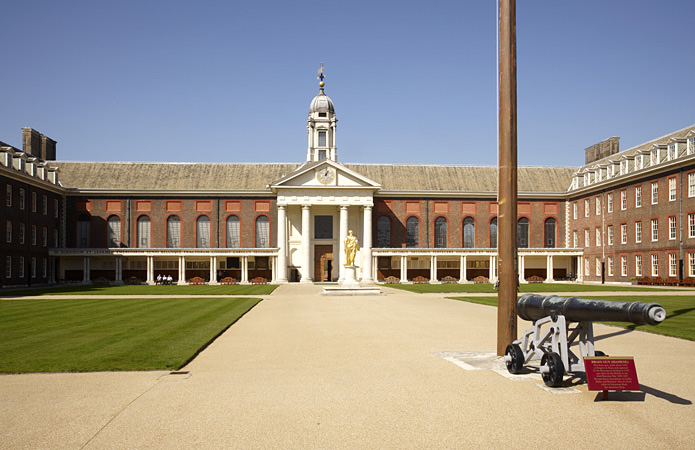
However, the palatial parallel persists. A great three sided quad, with a royal statue at its centre, opens out onto lawns running down to the Thames, coupled with the large wings and pavilions, one cannot help but get a whiff of Hampton Court or similar. It is only the lack of ostentatious ornament that betrays the fact that this is not an aristocratic or royal habitation.
What it is, in fact, is Wren’s greatest lesson in decorum. Once you are stood in the ordered embrace of its barrack like blocks, you have to ask yourself what else could an army retirement home look like? The strong solemnity of the giant order, the rustic reliability of the red brick, the orderly unornamented windows seemingly express all the aspirational qualities of the English soldier, while also implying the imposing grandeur required of the nations ‘heroes.’
Within the be-lanterned central block there is housed, college-like, the great hall and the chapel and, between them, all regimentality of the exterior disappears. The Great Hall is a singularly uninteresting cuboid overseen by Atonito Verio’s, not altogether successful, yet enormous, wall paintings of an equestrian Charles II in allegorical majesty before a vision of the hospital itself, at which it is best not to look too closely.

It’s hard to believe that the chapel opposite is its structural twin. This is, for me, one of Wren’s most successful church interiors, differentiated from the Great Hall by its singular barrel vault that runs the length of the space, dispensing with aisles and crossings and culminating in a painted half dome apse – the excellent work of Sebastiano Ricci here makes a counterpoint to Verio’s rather lacklustre performance. However, the real star in the chapel is light – shafts that cut a diagonal through the space burst from the south-facing, round-topped windows along one side, only adding to the overall ambience of quiet divinity.
If it is to be found anywhere at Chelsea, the baroque lies in the chapel, but not the flamboyance of the continental baroque, nor the playful invention of the later English style, but rather that personal brand of Wren’s, the quiet, enlightened, intellectual baroque.
Enjoyed this article? Why not buy me a coffee to fuel more? Click here: https://ko-fi.com/morganhaigh

 Morgan Haigh