
The latest development in the ongoing campaign to squeeze every last penny out of each square foot of our urban space, Façadism is on the rise across London. This now highly fashionable practice is doing nothing more than placing a mask of faux respectability over the continued butchering of our city’s architectural heritage.
Façadism, the practice of retaining nothing but the façade of an old building, whilst the rest is gutted and reconstructed to fit modern tastes behind the old front, does have its uses. And before I launch into a full tirade, it is worth remembering that, in cases of fire, collapse, or structural issue, it can help preserve important architecture that would otherwise have been lost. However, the kind of Façadism that I am going after is the kind increasingly seen taking form behind the many hoardings of London.
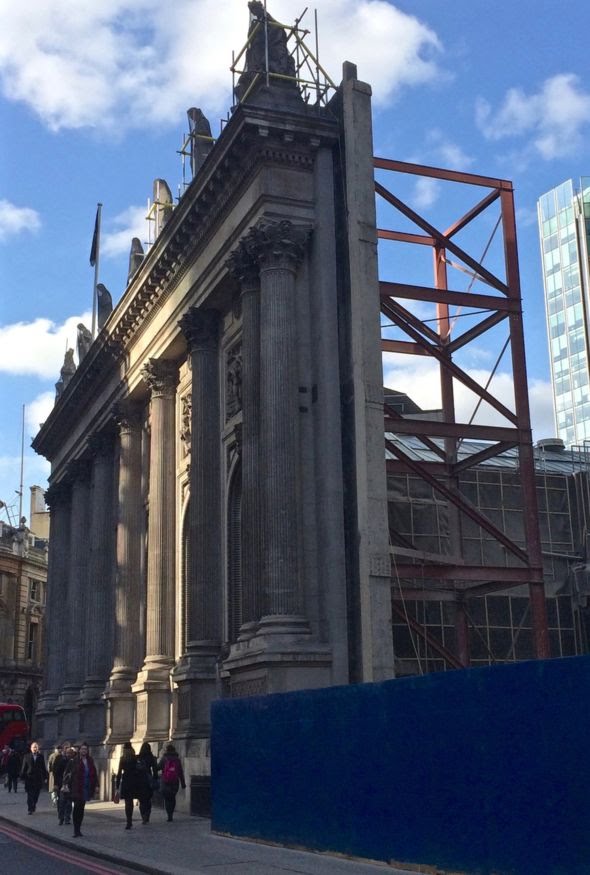
Whether in Soho or Mayfair, The City or Kennsington, one is often now confronted by these ghost buildings, their fenestration open to the sky, usually propped up by an interlocking ivy of girders and scaffolding. The tragedy is that often these buildings are the most significant ones in the area and it is their important sites that attract the faceless conglomerates in droves – the building itself becomes nothing but an obstacle to be overcome in the name of the march of ‘progress’.
In most cases, if the investors could have their way, the building would be entirely erased and replaced with such work as Norman Foster and co. It is usually only the somewhat ineffective planning laws that stop this. Instead they are told that they must keep something of the external appearance of the original, often listed, building and thus, not with a bang but a whimper, the death warrants of many wonderful and important interiors have been signed. Or, alternatively, a company might choose to keep a nice classical façade of its own volition, to feed a twisted corporate ego, an attempt to correlate their values with that of great culture.
Now, this is not the case with every example of Façadism, I will grant you. Indeed many lordable rejuvenations of old industrial buildings have been produced and the loss of their utilitarian, uniform interiors is not a great one to society. But when one sees such current projects as the old National Provincial Bank in Threadneedle Street, or the monstrous gutting of the London Fruit and Wool Exchange in Spitalfields, it is hard not to lament the wanton destruction of, not only beautiful and unique interiors, but the very souls of these buildings all in the pursuit of capital.
Façadism reduced the idea of a building and its architecture down to nothing but a commodity, with a face onto the street. It entirely discounts the integral connection between the exterior and the rooms within, to detach these two symbiotic parts is to misunderstand our relationship with our built environment and the important role it plays in our lives – our buildings are the stage set on which we act out our parts.
It is often the case that whatever is built behind these ghostly remains of buildings is hideous, almost like the kept façade excuses the designers any need to consider aesthetics at all. They often bear no relation to the form of the façade, with no effort made to coordinate the windows and doors – the corporate annoyance with being made to preserve the old façade is made visible in these half-arsed efforts. The two most heinous examples of this are both student accommodation for the University of London, making me ashamed of my alma mater, they sit on Caledonian Road and Artillery Lane respectively.
I am by no means advocating a strictly conservative architectural agenda. On the contrary, I believe that a city that cannot grow and change its architecture dies. But when a building is really worth saving, in other words, it is listed, this should protect the whole fabric of that buildings, not just its masonry mask. Surely, in this environmentally aware age, we should be looking at how we can recycle old buildings rather than waste so much in tearing down and building anew.
There are many fine examples in London of old buildings being re-purposed for modern functions. Take, for example, The Ned, now the epicentre of The City’s social life, this bar and hotel was once the Midland Bank and both its 1920s, Lutyens designed, interior and exterior have been preserved perfectly and even enhanced by the new occupants.
So this is a plea to the planners and the faceless multinationals of London: when a building is worth saving, don’t just save its face, but also its soul.

 Morgan Haigh